What's inside
- Best brushless cordless heat guns at a glance
- Milwaukee M18 FUEL 2688-20: best for fast, repeatable heating
- Makita DHG181Z: best for temperature and airflow control
- Head-to-head: which one matches the job?
- Runtime: what to expect from an 18V battery
- Nozzles are as important as temperature
- Durability and ownership details
- Buying decision by situation
- Safe technique for controlled heating
- Best brushless cordless heat guns at a glance
- Milwaukee M18 FUEL 2688-20: best for fast, repeatable heating
- Makita DHG181Z: best for temperature and airflow control
- Head-to-head: which one matches the job?
- Runtime: what to expect from an 18V battery
- Nozzles are as important as temperature
- Durability and ownership details
- Buying decision by situation
- Safe technique for controlled heating
As an Amazon Associate I earn from qualifying purchases. This post may contain affiliate links at no extra cost to you.
The best brushless cordless heat gun for most portable work is the Milwaukee M18 FUEL 2688-20, while the Makita DHG181Z is the better choice when you need finer temperature control and higher airflow for bending plastic or working with shrink tubing.
As an Amazon Associate we earn from qualifying purchases at no extra cost to you.

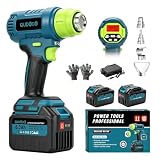


Best brushless cordless heat guns at a glance
These tools solve the same problem in different ways. Milwaukee prioritizes rapid warm-up and a simple, high-output design; Makita offers a broader temperature range and two airflow levels. Battery-platform compatibility should also influence the decision: a bare tool is economical only if you already own compatible batteries and a charger.
| Model | Temperature range | Airflow settings | Warm-up | Approx. tool-only weight | Best suited to |
|---|---|---|---|---|---|
| Milwaukee M18 FUEL 2688-20 | 500°F and 875°F | Single operating airflow | About 7 seconds to high heat | About 1.7 lb | Fast stripping, adhesive removal, general repairs |
| Makita DHG181Z | 122°F–1,022°F; up to 550°C | 120 or 200 L/min | About 6 seconds to maximum heat | About 1.7 lb | Plastic bending, shrink tubing, controlled heating |
| Typical 18V brushed cordless heat gun | Usually around 550°F–1,000°F | Usually one level | Often 15–45 seconds | About 1.5–2.0 lb | Occasional low-cost use |
Published figures can vary by market, battery, temperature setting, and measurement method. Battery, charger, and nozzle kits are commonly sold separately. Expect a bare brushless tool to fall broadly in the $100–$200 range, with a battery-and-charger kit often adding roughly $80–$200 depending on platform capacity.
Milwaukee M18 FUEL 2688-20: best for fast, repeatable heating
The M18 FUEL 2688-20 is the strongest pick when warm-up time matters more than fine adjustment. Its two temperature settings, approximately 500°F and 875°F, cover common tasks such as loosening adhesive, softening vinyl, removing labels, thawing small frozen fittings, and stripping paint from localized areas.
Its key advantage is speed: Milwaukee specifies roughly seven seconds to operating temperature. That makes it practical for electricians, maintenance technicians, and remodelers who repeatedly pick up and set down the tool. The brushless motor also avoids replacing carbon brushes and generally offers better efficiency than a comparable brushed design.
The limitation is control. Two temperature choices are useful, but they do not provide the gradual adjustment available from the Makita. High heat can also damage thin plastic, scorch wood, blister paint, or melt wire insulation if the nozzle is held too close. For shrink tubing, the Milwaukee is effective, but a lower-output or variable-temperature tool gives more margin around small connectors.
Choose the Milwaukee if:
- You already own M18 batteries.
- You value seven-second warm-up over precise temperature selection.
- You mostly strip paint, soften adhesives, or perform general repair work.
- You need a tool that can be used frequently without brush replacement.
Makita DHG181Z: best for temperature and airflow control
The Makita DHG181Z is the more versatile choice for heat-sensitive materials. Its temperature is adjustable from approximately 122°F to 1,022°F, and its two airflow levels are rated around 120 and 200 L/min. That combination lets you use gentle heat on cable insulation or shrink tubing, then switch to higher heat and airflow for paint removal or forming plastic sheet.
Makita also specifies rapid heating, reaching maximum temperature in roughly six seconds. The low temperature range is particularly useful for jobs where the goal is to warm rather than melt: loosening labels, drying small areas, softening sealants, or reducing the stiffness of tubing before installation.
With the right nozzle, it is the better brushless cordless heat gun for controlled plastic bending. A reflector or wide slot nozzle spreads heat over a larger section, reducing the risk of creating a sharp hot spot. For shrink tubing, a reduction nozzle concentrates heat around the tube while keeping the rest of the assembly farther from the air stream.
Choose the Makita if:
- You work with plastics, wiring, vinyl, or other heat-sensitive materials.
- You need separate temperature and airflow choices.
- You already use Makita 18V LXT batteries.
- You want one tool for both delicate shrink tubing and hotter stripping work.
Head-to-head: which one matches the job?
| Task | Preferred setting | Better match | Reason |
|---|---|---|---|
| Paint stripping | High temperature, moderate movement | Milwaukee M18 FUEL | Fast warm-up and strong high-heat output simplify repeated passes. |
| Heat-shrink tubing | 250°F–500°F, lower airflow near small connectors | Makita DHG181Z | Variable temperature reduces the chance of scorching insulation. |
| Plastic bending | Low-to-medium heat, broad airflow | Makita DHG181Z | Adjustable temperature and airflow make gradual heating easier. |
| Adhesive and label removal | Low or medium heat | Either; Makita for delicate surfaces | Milwaukee is faster to deploy; Makita offers more control. |
| Occasional household repairs | Simple, infrequent use | Whichever matches your battery system | Platform cost matters more than small differences in output. |
Runtime: what to expect from an 18V battery
Heat guns are demanding tools because their heating element consumes much more power than a drill motor. Runtime depends heavily on the temperature setting and how often the trigger is released. A 5.0Ah 18V battery stores roughly 90Wh before electrical and heat losses are considered. If the heat gun averages 600W while running, the theoretical continuous runtime is:
90Wh ÷ 600W = 0.15 hours, or about 9 minutes.
Real usable time may be lower because the battery cannot deliver all of its rated energy at the tool’s peak load, and high-temperature operation may trigger thermal protection. In intermittent work, however, a battery can last through many more physical tasks: a 10-second heating pass followed by a 20-second repositioning period uses only one-third as much active heating time as continuous operation.
For regular stripping or job-site use, a 5.0Ah or 6.0Ah pack is a practical compromise. Compact 2.0Ah packs make the tool lighter but may provide only a few minutes of sustained high-heat use. Larger packs extend runtime but add weight and can make overhead work tiring.
Nozzles are as important as temperature
- Reduction nozzle: Concentrates heat for shrink tubing, spot-softening adhesive, and small metal fittings. Keep it moving to avoid scorching.
- Wide or surface nozzle: Distributes heat across a larger area for paint stripping and warming broad plastic sections.
- Reflector nozzle: Wraps warm air around tubing or pipe, producing more even shrinkage than aiming the bare outlet at one side.
- Glass-protection nozzle: Deflects some heat from a window while directing warmth toward a frame or paint edge. It reduces risk but does not make glass immune to thermal shock.
Check the nozzle diameter and attachment method before buying accessories. A universal-looking nozzle may wobble, block the outlet, or sit too close to the plastic housing. Never use an attachment that obstructs airflow unless the manufacturer lists it for that model.
Durability and ownership details
Brushless construction removes carbon-brush wear, but it does not make a heat gun maintenance-free. The heating element, airflow path, switch, and plastic nozzle collar are the parts most exposed to wear. Fine dust can accumulate around the intake and reduce cooling, while melted adhesive can contaminate the outlet if the tool is placed on a hot surface.
After each session, let the tool run briefly at its lowest practical setting, if the manufacturer permits, then allow it to cool before storage. Remove the battery, brush dust from the intake, and inspect the nozzle for hardened material. Do not scrape the heating element with metal tools. If airflow becomes weak, the housing smells of burning plastic, or the tool repeatedly shuts down, stop using it until the cause is identified.
Buying decision by situation
| Your situation | Recommended direction | Why |
|---|---|---|
| Already own M18 batteries; frequent stripping | Milwaukee M18 FUEL 2688-20 | The platform reduces total cost and the rapid warm-up suits repetitive work. |
| Already own Makita LXT batteries; mixed materials | Makita DHG181Z | Its broader adjustment range is more forgiving on plastics and wiring. |
| Beginner working near vinyl or insulation | Makita DHG181Z | Lower settings help prevent accidental melting and scorching. |
| Very occasional use and no battery platform | Compare a corded variable-temperature model | A corded tool may cost less overall and provide longer continuous runtime. |
Safe technique for controlled heating
- Remove nearby combustible materials and confirm that the workpiece can tolerate heat.
- Fit the correct nozzle before installing the battery.
- Start at the lowest effective temperature and airflow.
- Keep the nozzle moving in overlapping passes rather than heating one point continuously.
- Test a hidden area first, especially on painted surfaces, laminates, plastics, and finished wood.
- Release the trigger before setting the tool down, and allow the nozzle to cool on a non-combustible surface.
For most owners, the choice is simple: select the Milwaukee M18 FUEL when rapid high-heat work is the priority, and select the Makita DHG181Z when temperature range, airflow control, and material protection matter more. In either case, the correct battery size and nozzle usually have as much effect on day-to-day usefulness as the heat gun itself.