
What's inside
- 1. What Types of Circular Saws Can You Find at Home Depot?
- 2. How to Choose the Right Circular Saw at Home Depot
- 3. Popular Circular Saw Options at Home Depot
- 4. Which Circular Saw Should You Choose for Different Projects?
- 5. Choosing the Right Circular Saw Blade
- 6. Essential Accessories to Consider
- 7. Circular Saw Safety: What to Check Before Cutting
- 8. Frequently Asked Questions
- Conclusion
As an Amazon Associate I earn from qualifying purchases. This post may contain affiliate links at no extra cost to you.
Shopping for a Home Depot circular saw can be confusing when you have to choose between corded and cordless models, different blade sizes, motor configurations, and prices. Whether you’re building a deck, cutting plywood, framing a wall, or completing home renovations, the right circular saw can make the work more manageable.
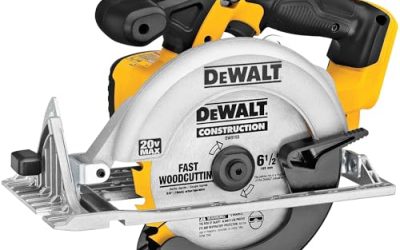
The best choice depends on the materials you plan to cut, how frequently you use the tool, and whether you already own compatible cordless batteries. Home Depot carries circular saws from brands such as DEWALT, Makita, and RYOBI, with options for occasional DIY projects and more demanding construction work.
For most homeowners, a 7-1/4-inch circular saw is a practical starting point because it supports a broad range of common woodworking and framing applications. However, a smaller cordless saw may be easier to handle for lighter projects, while a corded model can be more convenient for extended cutting sessions near an electrical outlet.
This guide explains what to look for when buying a circular saw at Home Depot, how to compare available options, which accessories matter, and what safety considerations should influence your purchase.
1. What Types of Circular Saws Can You Find at Home Depot?
Circular saws use a rotating toothed blade to make straight cuts through materials. The appropriate blade determines which materials a particular saw can handle.
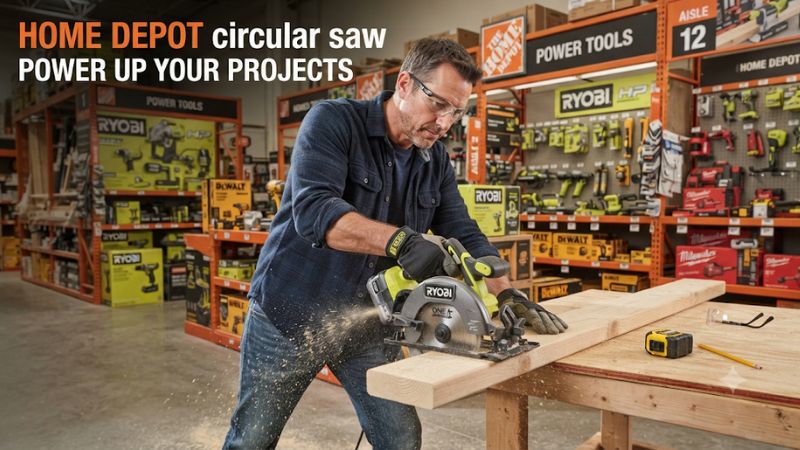
Home Depot’s selection includes corded and cordless models, with differences in power source, blade diameter, portability, and intended workload.
Corded Circular Saws
Suitable for workshops, home renovations, and extended cutting sessions.
A corded circular saw receives electricity directly from an outlet. Unlike cordless models, it does not depend on battery capacity or charging time.
Common characteristics include:
-
Consistent electrical power while connected to a suitable outlet.
-
No battery replacement or charging interruptions.
-
A suitable option for cutting plywood, dimensional lumber, and other approved materials.
-
Continuous access to power, provided the electrical supply is appropriate.
Many traditional full-size circular saws use 7-1/4-inch blades and motors rated between 13 and 15 amps.
For example, the DEWALT DWE575 is a 15-amp corded circular saw with a 7-1/4-inch blade. Its manufacturer specifies a maximum cutting depth of 2-9/16 inches and a bevel capacity of 57 degrees. These specifications make it suitable for various framing and woodworking applications.
The main disadvantage is the power cord. It can restrict movement, become tangled around materials, or create a tripping hazard if the work area is poorly organized.
Cordless Circular Saws
Suitable for mobile work and locations without convenient outlet access.
Cordless circular saws operate using rechargeable batteries. They are useful for outdoor construction, roof work, property maintenance, and projects where moving between cutting locations is necessary.
Their main advantages include:
-
Greater mobility around the job site.
-
No extension cord required.
-
Convenient setup for occasional cuts.
-
Compatibility with other tools when they share the exact battery platform.
However, battery capacity and tool configuration affect runtime and cutting performance. A cordless saw may also become heavier when a larger battery is installed.
Before purchasing, check whether the package includes a battery and charger. A tool-only package can appear less expensive but may require additional purchases.
Compact Circular Saws
Compact circular saws use smaller blades and are designed for users who prioritize portability and access in tighter working spaces.
They can be useful for cutting thinner boards, panels, and certain flooring materials, provided the blade and tool specifications support the application.
Their limitation is cutting depth. A compact saw should not be selected simply because it is easier to carry if the intended material exceeds its rated cutting capacity.
2. How to Choose the Right Circular Saw at Home Depot
Choosing a circular saw involves more than comparing prices or motor ratings. You should consider the type of material, cutting depth, frequency of use, and the amount of control you need.
1. Choose the Right Blade Diameter
Blade diameter determines the maximum cutting depth a saw can achieve. The most common option for general-purpose woodworking is 7-1/4 inches.
| Blade size | Typical applications | Main limitation |
|---|---|---|
| 4-1/2 inches | Thin panels and lightweight DIY work | Limited cutting depth |
| 5-1/2 to 6-1/2 inches | Smaller boards and portable cutting | Less depth than full-size models |
| 7-1/4 inches | Framing lumber, plywood, and general construction | Larger and potentially heavier |
| 10 inches or larger | Specialized cutting applications | Less convenient for everyday handheld work |
These are general application categories, not guaranteed cutting capacities. Always check the manufacturer’s stated depth at 90 and 45 degrees.
For homeowners who frequently cut standard dimensional lumber, a 7-1/4-inch model offers useful versatility. If you mainly work with thin plywood or flooring, a compact saw may be sufficient.
2. Compare Motor Power and Cutting Performance
For corded circular saws, motor power is commonly expressed in amps (A).
A 13-amp saw may be sufficient for occasional home projects, while a 15-amp model is worth considering for frequent framing and demanding cutting applications.
However, amperage alone does not establish cutting performance. Blade sharpness, material density, cutting technique, motor design, and blade speed also influence the result.
For cordless models, pay attention to the battery platform and the manufacturer’s performance specifications. Do not assume that every 20V MAX or 18V battery produces the same runtime or cutting performance.
3. Consider Bevel and Depth Adjustments
A circular saw should allow you to adjust cutting depth and bevel angle without unnecessary difficulty.
A bevel adjustment lets you tilt the base plate to make angled cuts. This is useful when building roof components, furniture, frames, and other projects requiring angled edges.
Check these features before purchasing:
-
Maximum bevel angle.
-
Common bevel stops, such as 45 degrees.
-
Cutting depth at 90 degrees.
-
Cutting depth at maximum bevel.
-
Ease of adjusting and locking the base plate.
For example, the DEWALT DWE575 supports bevel adjustments up to 57 degrees, with stops at 45 and 22.5 degrees. Its maximum cutting depth is 2-9/16 inches.
These figures describe the specific model, not every 7-1/4-inch circular saw.
dewalt.com+1
4. Check the Weight and Handle Design
Weight affects how comfortably you can guide a circular saw, especially when making repeated cuts or working with large panels.
A lighter model may be easier for occasional DIY users to control. However, you should not automatically choose the lightest saw available.
Pay attention to:
-
Main handle position and grip comfort.
-
Auxiliary handle accessibility.
-
Balance when holding the saw.
-
Visibility of the cutting line.
-
Ease of reaching depth and bevel controls.
If possible, hold the tool before purchasing. Check whether you can maintain a stable two-handed grip without straining your wrists.
5. Look for Useful Features
Some additional features can make a circular saw easier to use.
| Feature | Practical benefit |
|---|---|
| Electric brake | Stops the blade more quickly after trigger release |
| Spindle lock | Makes blade replacement easier |
| Dust blower | Helps clear debris from the cutting line |
| Dust port | Allows connection to compatible dust extraction equipment |
| Laser guide | Projects a reference line onto the workpiece |
| Rip fence | Helps maintain straight, parallel cuts |
| LED work light | Improves visibility in poorly lit areas |
| Magnesium components | Can reduce weight in certain saw designs |
An electric brake is useful, but it does not replace safe handling or waiting for the blade to stop before setting the tool down.
Likewise, a laser guide does not guarantee a straight cut. A properly secured straightedge and controlled cutting technique remain important.
Home Depot’s circular saw buying guide also identifies blade-change systems, dust management, rip fences, and base construction as relevant purchasing considerations.
The Home Depot
3. Popular Circular Saw Options at Home Depot
Home Depot’s catalog includes several established power-tool brands. The following models illustrate different purchasing priorities rather than representing a hands-on performance ranking.
| Model | Power source | Blade size | Best suited for |
|---|---|---|---|
| RYOBI CSB125 | Corded, 13 amp | 7-1/4 in. | General DIY cutting |
| RYOBI CSB135L | Corded, 14 amp | 7-1/4 in. | DIY users interested in laser alignment |
| RYOBI CSB144LZK | Corded, 15 amp | 7-1/4 in. | Users wanting an included edge guide |
| DEWALT DWE575 | Corded, 15 amp | 7-1/4 in. | General construction and woodworking |
| DEWALT DWE575SB | Corded, 15 amp | 7-1/4 in. | Users wanting an electric brake and carrying bag |
| Makita 5007F | Corded, 15 amp | 7-1/4 in. | General-purpose woodworking |
Specifications and package configurations should be confirmed against the exact regional product listing before purchase.
RYOBI CSB125: An Option for Basic DIY Projects
The RYOBI CSB125 is a 13-amp corded circular saw with a 7-1/4-inch blade.
It is worth considering for homeowners who need a traditional circular saw for basic cutting tasks without investing in a cordless battery platform.
Its corded configuration avoids battery charging requirements, although users must manage the power cable during operation.
Buy if: You need a straightforward circular saw for occasional home improvement and woodworking.
Skip if: You specifically need cordless mobility or advanced cutting features.
RYOBI CSB135L: A Corded Saw With Laser Alignment
The RYOBI CSB135L uses a 14-amp motor and a 7-1/4-inch blade. Its laser alignment feature provides a visual reference when following a cutting line.
This feature may help when positioning the saw, but it should not replace accurate measurements or a physical cutting guide.
Buy if: You prefer a corded saw with an additional visual alignment aid.
Skip if: You work primarily in locations without convenient electrical outlets.
DEWALT DWE575: A Lightweight Full-Size Option
The DEWALT DWE575 combines a 15-amp motor with a 7-1/4-inch blade.
Its manufacturer lists a weight of 8.8 pounds, a 57-degree bevel capacity, and a maximum cutting depth of 2-9/16 inches.
The model also includes a dust blower and an anti-snag lower blade guard.
The DWE575 is worth considering for users who want a traditional corded saw for regular woodworking and construction tasks. Its weight specification should not be confused with the weight of every similarly sized circular saw.
Buy if: You want a full-size corded model with useful bevel and cutting-depth capabilities.
Skip if: Your priority is cordless operation or a particularly compact tool.
Makita 5007F: A 15-Amp Corded Alternative
The Makita 5007F is another 7-1/4-inch, 15-amp corded circular saw listed in Home Depot’s catalog.
It is a reasonable model to compare against other full-size corded saws when evaluating handle comfort, base construction, blade visibility, and package contents.
Do not assume that two 15-amp saws will deliver identical cutting performance. Their motor designs, gearing, blade configurations, and handling characteristics can differ.
Buy if: You prefer to compare established corded saw designs before choosing a general-purpose model.
Skip if: You need a battery-powered tool or a smaller saw for occasional lightweight work.
The Home Depot+2
4. Which Circular Saw Should You Choose for Different Projects?
Your intended workload should determine the type of circular saw you purchase.
| Project | Recommended configuration | Important consideration |
|---|---|---|
| Cutting plywood | 7-1/4-inch or suitable compact saw | Use a blade designed for plywood |
| Cutting framing lumber | 7-1/4-inch circular saw | Verify cutting depth |
| Building a wooden deck | 7-1/4-inch corded or cordless saw | Consider portability and workload |
| Cutting flooring | Compact saw or appropriate full-size model | Match blade type to flooring material |
| Furniture construction | Suitable circular saw with a fine-tooth blade | Prioritize cut quality and guidance |
| Repeated workshop cutting | 15-amp corded model | Consider dust extraction and work support |
A circular saw is primarily designed for straight cutting. If your project requires repeated precision angles, curved cuts, or intricate shapes, another saw type may be more appropriate.
For example, a miter saw is generally better suited to repeated crosscuts at controlled angles, while a jigsaw is more appropriate for curved cuts.
Corded or Cordless: Which Makes More Sense?
Choose a corded circular saw when:
-
You work near suitable electrical outlets.
-
You regularly make multiple cuts.
-
You do not want to purchase additional batteries.
-
You primarily use the tool in a workshop.
Choose a cordless circular saw when:
-
You move frequently between work locations.
-
You work outdoors or in areas without convenient outlets.
-
You already own compatible batteries and chargers.
-
You prioritize portability over avoiding battery-related costs.
For occasional homeowners, a corded model may offer a simpler purchase. For contractors and frequent DIY users already invested in a compatible cordless platform, a cordless model may provide greater convenience.
5. Choosing the Right Circular Saw Blade
Buying the saw is only part of the decision. You also need the correct blade for the material and finish you want.
Circular saw blades differ in tooth count, tooth design, diameter, arbor size, and intended application.
Blade Tooth Count
The number of teeth affects how the blade interacts with the material.
-
24-tooth blades: Commonly used for fast, relatively rough cuts in construction lumber.
-
40-tooth blades: Offer a useful balance between cutting speed and finish for general woodworking.
-
60-tooth blades: Often used when cleaner cuts are important, including certain plywood and finish applications.
These are general guidelines. Actual results depend on blade geometry, material, saw speed, and manufacturer recommendations.
Match the Blade to the Material
| Material | Blade type to consider |
|---|---|
| Construction lumber | Carbide-tipped framing blade |
| Plywood | Plywood or fine-finish blade |
| Hardwood | Hardwood-compatible carbide blade |
| Laminate | Blade specifically rated for laminate |
| Aluminum | Manufacturer-approved nonferrous metal blade |
Never assume a blade fits simply because its diameter matches the saw.
Before purchasing, verify:
-
Blade diameter matches the saw’s specifications.
-
Arbor-hole diameter and shape match the mounting hardware.
-
Maximum blade RPM rating meets or exceeds the saw’s operating speed.
-
Tooth design is appropriate for the material.
-
The manufacturer permits the intended application.
Important: The DEWALT DWE575 manual specifies wood-cutting applications and prohibits using that model to cut metal, plastic, concrete, masonry, or fiber cement. A different blade does not automatically make an unsuitable saw safe for another material.
dewalt.com
6. Essential Accessories to Consider
When comparing circular saws at Home Depot, consider the additional equipment needed to complete your projects.
-
Extra circular saw blades: Keep suitable replacement blades available for different woodworking applications.
-
Straightedge guide: Helps maintain consistent cutting lines on plywood and large panels.
-
Clamps: Secure the workpiece or cutting guide to prevent movement.
-
Dust extraction equipment: Helps manage airborne sawdust when connected to a compatible dust port.
-
Hearing protection: Reduces exposure to cutting noise.
-
Eye protection: Helps protect against flying wood chips and debris.
For cordless models, also check battery capacity, charger compatibility, and whether the package includes the required accessories.
Compare the total cost of ownership rather than looking only at the advertised tool price.
7. Circular Saw Safety: What to Check Before Cutting
Circular saws have rotating blades capable of causing serious injuries. Safe operation requires correct setup, appropriate protective equipment, and proper workpiece support.
Follow the specific instructions in your saw’s operating manual.
Before Starting
-
Inspect the blade for cracks, missing teeth, and damage.
-
Check that the upper and lower blade guards operate correctly.
-
Disconnect the power source before changing blades or making adjustments.
-
Confirm that the blade is suitable for the material.
-
Wear appropriate eye and hearing protection.
-
Use suitable respiratory protection when dust conditions require it.
-
Remove loose clothing and jewelry.
-
Secure the workpiece on a stable support.
During Cutting
-
Mark the cutting line clearly.
-
Adjust the cutting depth according to the manufacturer’s instructions. The DEWALT manual recommends that less than one full tooth should extend below the workpiece.
-
Support both sides of the material so the blade does not become trapped as the cut progresses.
-
Keep both hands on the designated saw handles.
-
Keep your hands away from the cutting path.
-
Allow the blade to reach operating speed before beginning the cut.
-
Maintain control without forcing the saw through the material.
Kickback can occur when the blade binds or becomes trapped in the workpiece. Incorrect blade depth, poor material support, and damaged or unsuitable blades can contribute to this hazard.
OSHA specifically identifies kickback, flying particles, and contact with the blade as hazards associated with handheld circular saws.
Occupational Safety and Health Administration+1
Never disable the blade guard or attempt to stop a rotating blade by hand. If the saw binds, release the trigger, disconnect the power source when safe, and wait for the blade to stop before investigating.
8. Frequently Asked Questions
Is a 7-1/4-inch circular saw good for home use?
Yes, a 7-1/4-inch circular saw is a versatile choice for many household woodworking and construction projects. It can handle common tasks such as cutting plywood and framing lumber when paired with an appropriate blade.
Is DEWALT or RYOBI better for a circular saw?
Neither brand is automatically better for every homeowner. RYOBI offers corded options for general DIY work, while DEWALT provides models such as the DWE575 with documented specifications suited to regular construction applications. Compare the exact models, features, price, and intended workload.
Does Home Depot sell circular saws without batteries?
Yes, cordless circular saws may be available as tool-only packages. These packages generally exclude the battery and charger, so check the included-items section before purchasing. Corded models do not require batteries.
What size circular saw should a beginner buy?
A 7-1/4-inch circular saw is a practical starting point for beginners who expect to handle different woodworking and home renovation projects. Choose a model that feels manageable, has accessible adjustments, and includes functioning blade guards.
Conclusion
Finding the right Home Depot circular saw starts with understanding your projects rather than choosing the most expensive or powerful model.
For general home improvement, a 7-1/4-inch circular saw offers useful cutting versatility. A corded 13- to 15-amp model is worth considering for workshop use and regular cutting, while a cordless model makes more sense when portability is a priority.
Compare blade compatibility, cutting depth, bevel adjustments, weight, safety features, and included accessories before making your decision. A well-matched circular saw can become a valuable part of your workshop for woodworking, construction, and future home improvement projects.
The best purchasing decision is the saw that matches your materials, workload, experience, and budget without paying for features you will rarely use.
Related guides
More from Amazon
Programs that pair well with the guide above. Offers and eligibility are set by Amazon and may change.
A free business account with business pricing and bulk-buying tools for work, shop or home office.
Create a business accountFree shipping on eligible items, Prime Video and more. Eligible new members can start with a free trial.
Start a Prime free trialAudiobooks and podcasts to listen to on the go. Eligible new members can start with a free trial.
Try Audible freeAd-free music streaming. Eligible new subscribers can start with a free trial.
Try Music Unlimited freeAs an Amazon Associate we earn from qualifying purchases.
Write Your Review
No reviews yet. Be the first to share your experience!