What's inside
- Are oscillating tool blades universal?
- Best universal oscillating multi tool blades by project
- Head-to-head comparison of universal-fit blade types
- Which blade set fits your situation?
- Compatibility, vibration, and cut quality
- A simple cost-per-use calculation
- Ownership tips that extend blade life
- Bottom line
- Are oscillating tool blades universal?
- Best universal oscillating multi tool blades by project
- Head-to-head comparison of universal-fit blade types
- Which blade set fits your situation?
- Compatibility, vibration, and cut quality
- A simple cost-per-use calculation
- Ownership tips that extend blade life
- Bottom line
As an Amazon Associate I earn from qualifying purchases. This post may contain affiliate links at no extra cost to you.
The best universal oscillating multi tool blades for mixed projects are usually open-interface blades with a reinforced bi-metal tooth line: they fit many OIS-style tools, cut wood with embedded nails more safely than carbon-steel blades, and cost less to standardize across several brands than buying a separate mount for every tool.
For most owners, a 34 mm or 35 mm wide bi-metal blade is the best starting point. Add a fine-tooth wood blade for clean trim cuts, a carbide-grit blade for grout or cement board, and a scraper for adhesive. That four-piece combination covers repair, remodeling, flooring, plumbing, and general woodworking without filling a toolbox with narrowly specialized accessories.
As an Amazon Associate we earn from qualifying purchases at no extra cost to you.

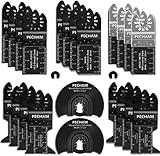


Are oscillating tool blades universal?
No. “Universal” generally means the blade uses an open mounting pattern compatible with many traditional oscillating tools, not that it fits every machine. Bosch OIS-style blades and similar open-interface blades commonly fit tools from Bosch, DEWALT, Dremel, Fein, Makita, Milwaukee, Rockwell, and other manufacturers, but exact compatibility depends on the tool’s clamp and whether it accepts non-Starlock accessories.
Starlock, StarlockPlus, and StarlockMax are separate mounting systems. Starlock blades are designed for Starlock-compatible tools and are not a universal substitute for ordinary open-interface blades. Some tools accept both systems through an adapter or interchangeable clamp, while others do not. Check the tool manual before buying a large assortment.
Universal multi tool blades are therefore best understood as cross-brand blades for a particular open mount, rather than one blade standard that fits everything. A blade that slides onto the arbor is not necessarily safe: the retaining bolt, washer, clamp depth, and tooth orientation must all match the tool.
Best universal oscillating multi tool blades by project
Best all-purpose choice: 34–35 mm bi-metal plunge blade
A medium-width bi-metal blade is the strongest general recommendation for mixed projects. Its high-speed-steel teeth are welded to a flexible alloy-steel body, allowing it to cut wood, plastic, drywall, and occasional nails or screws with less tooth breakage than a basic high-carbon-steel blade.
Choose a blade with teeth around 18–24 TPI for a balance of speed and control. A 34 mm blade reaches into corners while remaining easier to steer than a 65 mm blade. This is the useful size for cutting door jambs, copper or plastic pipe, flooring, shims, cabinet parts, and nail-embedded framing.
Best for clean woodworking: fine-tooth carbon-steel or HCS blade
For clean cuts in untreated wood, a sharp HCS blade with roughly 18–32 TPI usually leaves a cleaner surface than a rugged bi-metal blade. It is also less expensive. The trade-off is rapid wear if it contacts nails, screws, masonry, or abrasive laminate.
Use a narrow 20–25 mm blade when starting a plunge cut or trimming inside a tight corner. Use a 50–65 mm blade when you need a straighter, wider cut through trim or sheet material. More width improves reach but increases friction and makes the tool easier to twist.
Best for nails and renovation: premium bi-metal blade
When old trim may contain hidden fasteners, a bi-metal blade is worth the extra cost. Premium examples from established accessory ranges such as Diablo, Bosch, Milwaukee, DEWALT, and Fein are commonly available in open-interface or brand-specific versions. Select the open-interface version only when its mounting pattern matches your tool.
Bi-metal blades are not indestructible. Hardened screws, masonry dust, and repeated sideways levering can still chip the teeth or overheat the edge. Let the blade cut at its own pace instead of forcing the tool through metal.
Best for grout and cement board: carbide-grit blade
Carbide-grit blades have no conventional saw teeth; their abrasive edge removes grout, thin-set residue, cement board, and some fiberglass-reinforced materials. They are slower in wood but tolerate abrasive work far better than steel teeth.
A 2.5–3.5 mm narrow grout blade is useful for removing one damaged tile joint. A 10–20 mm width is faster for longer joints, but it is easier to damage adjacent tile. Carbide grit is usually the most expensive blade type in a mixed set, so buying one narrow and one medium blade is more economical than purchasing a large assortment.
Best for adhesive and caulk: rigid scraper
A rigid scraper is the right accessory for vinyl adhesive, carpet residue, silicone, paint drips, and stuck flooring. It does not replace a cutting blade: trying to slice framing with a scraper can bend the accessory or overload the tool’s clamp.
Head-to-head comparison of universal-fit blade types
| Blade type | Typical width | Tooth or edge material | Best materials | Expected working life | Typical market range |
|---|---|---|---|---|---|
| Fine-tooth wood blade | 20–65 mm | High-carbon steel, about 18–32 TPI | Clean wood, plastic, drywall | About 10–40 cuts, depending on material | $4–$10 each |
| General bi-metal blade | 25–35 mm | High-speed steel teeth on alloy-steel body, about 18–24 TPI | Wood with nails, plastic, light sheet metal | About 20–80 cuts | $7–$16 each |
| Wide bi-metal blade | 50–65 mm | Bi-metal, about 14–20 TPI | Longer trim cuts, framing, flooring | About 15–60 cuts | $9–$20 each |
| Carbide-grit grout blade | 2.5–20 mm | Tungsten-carbide abrasive grit | Grout, cement board, thin-set residue | About 3–15 m of grout | $12–$30 each |
| Rigid scraper | 32–65 mm | Hardened steel edge | Adhesive, caulk, paint, flooring residue | Several projects; edge can be resharpened | $6–$18 each |
These figures are practical ranges rather than guarantees. A blade cutting clean pine may last far longer than one cutting nail-filled hardwood, porcelain grout, or abrasive flooring adhesive.
Which blade set fits your situation?
| Your situation | Most useful starting set | Why it makes sense |
|---|---|---|
| Occasional homeowner repairs | Two 34–35 mm HCS blades, one bi-metal blade, one scraper | Low initial cost and coverage for trim, drywall, caulk, and light demolition |
| Frequent renovation work | Three bi-metal blades in 25, 35, and 65 mm widths plus carbide grout blade | Reduces downtime and handles hidden fasteners and longer cuts |
| Fine woodworking | Narrow fine-tooth blade and 35 mm precision wood blade | Better steering and cleaner cuts than coarse demolition teeth |
| Several tool brands | Open-interface blades from one consistent accessory range | Simplifies replacement stock, provided every tool accepts that mount |
| Tile and bathroom work | 2.5–3.5 mm carbide grout blade, 10–20 mm carbide blade, scraper | Targets abrasive joints and adhesive without wasting wood blades |
Compatibility, vibration, and cut quality
Mount fit comes first. A loose or incorrectly seated blade can vibrate, wander, and damage the clamp. Before use, remove dust from the arbor, seat the blade fully, and tighten the retaining fastener to the tool manufacturer’s specification. Do not add washers or modify the mounting hole to make an incompatible blade fit.
Vibration is influenced by more than the tool. Wide blades, bent bodies, coarse teeth, excessive pressure, and a partially tightened clamp all increase it. A shorter 25–35 mm blade normally feels smoother than a 65 mm blade because less metal is oscillating away from the pivot. For overhead work, a narrower blade can also reduce fatigue.
For the cleanest cut, mark both sides of the work, support the offcut, and start at a moderate speed. High speed is useful for thin wood and plastic, but reducing speed helps with metal and prevents plastic from melting. Keep the blade square to the surface; twisting the tool is a common cause of rough edges and premature tooth loss.
A simple cost-per-use calculation
Suppose a $12 bi-metal blade produces 40 useful cuts through nail-embedded trim. Its accessory cost is about 30 cents per cut. A $6 HCS blade that gives 20 clean cuts costs the same 30 cents per cut, but becomes poor value if used on hidden nails and ruined after two or three cuts.
The economical approach is not always buying the cheapest blade. Use HCS for clean, known material and reserve bi-metal for uncertain demolition. That separation often lowers total cost because the expensive blade is used where its added durability matters.
Ownership tips that extend blade life
- Inspect the teeth after each project. A missing tooth or blue discoloration indicates damage or overheating; replace the blade rather than forcing it to cut.
- Brush dust from the mounting area and wipe blades dry before storage. Moisture and abrasive dust accelerate clamp and edge wear.
- Do not use a wood blade to discover whether a wall contains nails. Use a bi-metal blade when fasteners are likely.
- Keep carbide-grit blades separate from ordinary saw blades so abrasive particles do not contaminate clean woodworking accessories.
- Stop when cutting speed drops noticeably. Pressing harder usually creates more heat and vibration instead of restoring performance.
- Store blades in a rigid case or divided container. Bent mounting plates can cause wobble even when the teeth remain sharp.
Bottom line
For users moving between multiple oscillating tool brands, buy confirmed open-interface universal oscillating tool blades rather than assuming every accessory is interchangeable. Start with a 34–35 mm bi-metal blade, add a fine-tooth HCS blade for clean wood, and choose carbide grit or a scraper for specialized renovation tasks. Verify the mount, match the blade material to the work, and treat width and tooth type as performance choices—not just price differences.