What's inside
- Carbide-toothed vs. carbide-grit blades
- Best choice by material and job
- Decision matrix: which carbide blade should you buy?
- Important specifications beyond the word “carbide”
- How to get longer life from an oscillating tool carbide blade
- Ownership cost: why the cheapest blade may not be the lowest-cost option
- Bottom line
- Carbide-toothed vs. carbide-grit blades
- Best choice by material and job
- Decision matrix: which carbide blade should you buy?
- Important specifications beyond the word “carbide”
- How to get longer life from an oscillating tool carbide blade
- Ownership cost: why the cheapest blade may not be the lowest-cost option
- Bottom line
As an Amazon Associate I earn from qualifying purchases. This post may contain affiliate links at no extra cost to you.
For hardened screws and nails, choose a carbide-toothed oscillating blade; for cement board, grout, and abrasive demolition, choose a carbide-grit blade, because the two designs remove material in very different ways.
The best carbide oscillating tool blades are not the most expensive or the most aggressively marketed. They are the ones matched to the material, cut shape, and amount of abuse you expect. A toothed blade cuts with individual carbide teeth, while a grit blade uses a bonded layer of tungsten-carbide particles as a miniature abrasive wheel.
As an Amazon Associate we earn from qualifying purchases at no extra cost to you.
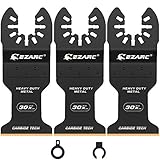


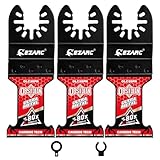
Carbide-toothed vs. carbide-grit blades
| Feature | Carbide-toothed blade | Carbide-grit blade |
|---|---|---|
| Best materials | Hardened screws, nails, thin steel, stainless fasteners, fiberglass | Grout, cement board, mortar, plaster, tile adhesive, abrasive composites |
| Typical cutting width | Approximately 1-1/4 to 2-1/2 inches | Approximately 1-1/4 to 2-1/2 inches |
| Typical useful thickness | Fasteners and sheet material up to about 1/8 inch, depending on blade design | Grout joints and surface layers roughly 1/8 to 3/8 inch deep per pass |
| Cut character | Faster, more controlled, with larger chips | Slower, dusty, and better suited to scraping or grinding |
| Risk of snagging | Moderate if the teeth catch or the blade is twisted | Low, although excessive pressure can overheat the blade |
| What wears first | Tooth tips or missing teeth | Grit layer and the edges of the backing plate |
These dimensions are useful buying ranges rather than universal ratings. Always check the manufacturer’s stated cutting capacity, shank pattern, and recommended material limits for the particular blade.
Best choice by material and job
Hardened screws and nails: carbide-toothed
A standard bi-metal oscillating blade can cut ordinary construction screws, copper pipe, and soft nails, but hardened fasteners quickly dull or burn it. A carbide-toothed blade for an oscillating tool is the better choice when a fastener is embedded in wood, sits flush against a bracket, or cannot be removed without damaging surrounding material.
Use a narrow or medium-width blade when access is restricted. A wider blade is steadier for exposed fasteners but can be difficult to position in a corner. The teeth should contact the fastener squarely. Rocking the blade sideways can break carbide teeth even when the material itself is within capacity.
Cement board and fiber-cement: carbide-grit
For cement board, a carbide-grit multi tool blade is usually more practical than a toothed design. The abrasive edge resists the mineral content that rapidly blunts ordinary steel teeth and produces a controlled cut for notches, outlet openings, and short trimming operations.
Carbide grit is not a substitute for a masonry saw on long, straight cuts. Oscillating tools are most effective for detail work, repair cuts, and areas where a larger tool cannot fit. Keep the blade moving and use light pressure; forcing it can generate heat and consume the grit layer quickly.
Grout removal: carbide-grit
For grout, select a blade whose thickness is close to the existing joint. A blade that is too narrow leaves grout behind, while one that is too wide can scrape tile edges or remove more joint material than intended. Common carbide-grit grout blades range from about 1/16 to 1/8 inch for narrow joints, with wider versions available for older installations.
Set the tool to a moderate speed, align the blade with the joint, and make several shallow passes instead of trying to reach full depth immediately. This improves control near tile corners and reduces the chance of slipping into the tile glaze.
Abrasive demolition: carbide-grit for surfaces, carbide teeth for metal
Carbide grit is the better all-purpose option for plaster, mortar residue, adhesive, and abrasive composite material. For demolition involving both masonry-like debris and metal fasteners, carry both designs. The grit blade handles the mineral material; the toothed blade handles nails, screws, and thin brackets.
Do not use a carbide-grit blade as a general metal cutter. It may abrade a thin nail, but it is inefficient on steel and can shed its abrasive coating. Conversely, a carbide-toothed blade may chatter across grout and lose teeth without making a useful cut.
Decision matrix: which carbide blade should you buy?
| Your situation | Recommended design | Useful specification | Reason |
|---|---|---|---|
| One occasional repair | Single carbide-toothed or grit blade matched to the job | 1-1/4 to 1-1/2 inch width | Lower initial cost and easier control |
| Frequent remodeling | One toothed blade plus one grout or grit blade | Two blades covering metal and mineral materials | Prevents using the wrong edge and extends service life |
| Limited workspace | Narrow carbide-toothed blade | About 1-1/4 inch width | Fits between framing, brackets, and trim |
| Long grout joints or repeated cement-board cuts | Wide carbide-grit blade | About 2 to 2-1/2 inches wide | Covers more material per pass and stays aligned |
| Hard fasteners in dense wood | Coarse carbide-toothed blade | Short cutting edge with visible carbide teeth | Removes hardened metal faster than abrasive grit |
Important specifications beyond the word “carbide”
Shank compatibility
Most current oscillating tools use a universal-style interface, but not every accessory fits every clamp system equally well. Check the blade’s mounting profile and the tool’s manual before buying. A loose fit can cause vibration, reduced cutting performance, and premature wear at the mounting hole.
Width and tooth layout
A 1-1/4-inch blade is easier to steer in tight spaces. A 2-inch or wider carbide multi tool blade provides a more stable reference on broad surfaces but needs more room to swing. Closely spaced teeth generally give a smoother cut in thin metal; aggressive, widely spaced teeth clear chips more readily when cutting a thicker fastener.
Offset and flush-cut geometry
An offset blade can reach beneath trim or cut a protruding fastener flush with a surface. A straight blade can provide better visibility and rigidity when there is open access. For flush work, confirm that the blade’s side profile—not just its teeth—can pass under the material without contacting the finished surface.
How to get longer life from an oscillating tool carbide blade
- Mark the cut and inspect for hidden metal. Locate pipes, wiring, and brackets before cutting. A carbide blade is not a reason to cut blindly.
- Start at a moderate speed. Let the teeth or grit establish a kerf before increasing speed. Maximum speed is not automatically fastest when the blade is overheating.
- Use light forward pressure. The blade should remove material while oscillating, not bend under force. Excessive pressure increases vibration and can fracture carbide teeth.
- Keep the blade square. Side-loading is a common cause of tooth breakage. If access requires twisting, stop and reposition the tool.
- Clear dust regularly. For carbide grit, packed dust reduces abrasion and traps heat. Pause, lift the blade from the cut, and allow the oscillation to clear debris.
- Inspect after cooling. Replace a toothed blade with several missing teeth, a visibly cracked backing plate, or severe wobble. A grit blade is spent when its abrasive edge is smooth, uneven, or no longer removes material at a reasonable rate.
For dusty cement-board and grout work, wear eye protection and suitable respiratory protection, follow the material manufacturer’s safety guidance, and use dust extraction where practical. Do not use water near an oscillating tool unless the tool and procedure are specifically designed for that environment.
Ownership cost: why the cheapest blade may not be the lowest-cost option
Suppose a general-purpose carbide-grit blade costs $18 and lasts through six small grout repairs. Its consumable cost is about $3 per repair. A $12 blade that lasts only two repairs costs $6 per repair, even though its purchase price is lower. The calculation is:
Cost per use = blade price ÷ useful jobs completed.
For occasional users, buying one precisely matched blade avoids paying for a multipack that may sit unused. For contractors or frequent remodelers, multipacks and a two-design kit can reduce interruptions, provided the blades are stored dry and labeled by material.
Bottom line
Choose carbide teeth when the job is primarily cutting hardened metal fasteners. Choose carbide grit when the job is primarily grinding grout, cement board, mortar, or other abrasive material. If demolition routinely includes both, a carbide blade oscillating tool setup with one blade of each type is more useful than trying to make one multi tool carbide blade do everything. Match the width to the workspace, match the thickness to the grout joint or material, and replace worn accessories before vibration or side-loading turns a controlled cut into a damaged surface.